Drivetrain
Motorcycle Chain Length Calculator
The standard ANSI roller-chain formula, applied to motorcycle pitches: 520, 525, 530, 428 and friends. Get a length you can order with confidence.
The formula
Chain length is a geometry problem: the chain wraps around two sprockets of different radii, so the path is a portion of two circles plus the two tangent runs in between. The closed-form approximation used industry-wide is:
L = 2·(C / p) + (F + R) / 2 + ((R − F) / (2π))² · (p / C)

L = chain length in links
C = center distance (inches)
p = chain pitch (inches; 0.625 for 520/525/530)
F = front sprocket teeth
R = rear sprocket teeth
The first term covers the two straight runs; the second is the half-wrap around each sprocket; the third is a small correction for the difference in sprocket sizes. Round the result up to the nearest even number for a master link.
Worked example
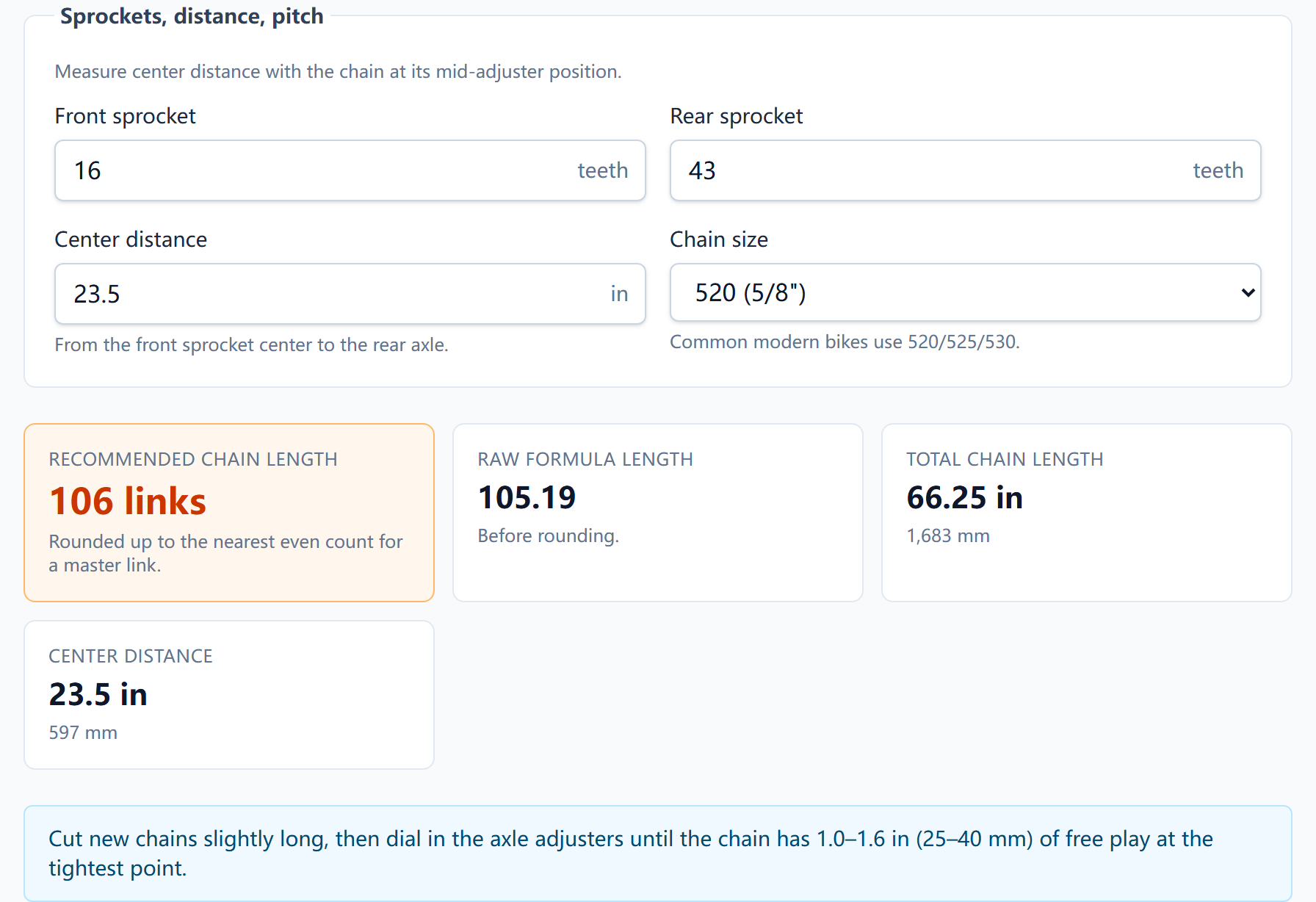
A common middleweight sportbike: 15 front, 45 rear, 520 chain (pitch 0.625 in), center distance 24 in.
- 2·(24 / 0.625) = 76.80 links of straight run
- (15 + 45) / 2 = 30 links of wrap
- ((45 − 15) / (2π))² · (0.625 / 24) ≈ 22.797 · 0.02604 ≈ 0.594 links of correction
- L ≈ 76.80 + 30 + 0.594 = 107.394 links → rounded up to 108 links
That’s a 108-link 520 chain, or 67.5 in of total length. A standard 120-link box from RK or DID gives you plenty of cut-off.
Formula source: ANSI B29.1 roller-chain standard; DID / RK manufacturer tables. Last reviewed: . Reviewed by the RiderCalc editorial team.
Frequently asked questions
What does a number like "520" mean on a motorcycle chain? +
The first digit is the pitch in eighths of an inch — 5 means 5/8" (0.625 in). The remaining digits are the roller width and inner-plate spacing in increments of 1/8 in. So 520, 525, and 530 all share the same 5/8 in pitch but get progressively beefier. 428 and 420 are smaller 1/2 in pitch chains used on lightweight bikes.
Why is the result rounded up to an even number? +
Roller chains are built from alternating inner and outer links. You can only cut and reconnect them at outer links, which means the total link count must be even so the master link sits in the right place. Rounding up gives you the chain just slightly long; the rear-axle adjusters take up the slack.
How do I measure center distance accurately? +
Set the rear-axle adjusters to roughly the middle of their range, then measure from the centerline of the front (countershaft) sprocket bolt to the centerline of the rear-axle nut. A long Vernier caliper or a steel ruler held against the swingarm both work.
Can I reuse my old chain length if I only change sprocket teeth? +
Sometimes. A one-tooth change at the rear typically shifts required chain length by less than two links and can be absorbed by the axle adjusters. Larger changes — for example a 15/45 to a 14/48 swap — usually need a new chain or at least a recount.
How tight should chain slack be? +
Most manufacturers specify 1.0–1.6 in (25–40 mm) of free play measured at the tightest point in the chain’s rotation. Too tight and you’ll overload the countershaft bearing; too loose and the chain can hop off the sprocket under power.