Drivetrain
Motorcycle Gear Ratio Calculator
A sprocket change is the cheapest power upgrade on a bike — if you pick the right teeth. See the side-by-side numbers before you order.
The formula
The drivetrain chain runs: engine → primary reduction → gearbox → final drive (front/rear sprockets) → wheel. Each stage multiplies, so:
Final drive    = Rear teeth / Front teeth
Overall ratio  = Primary × Gearbox(gear) × Final drive
Wheel RPM      = Engine RPM / Overall ratio
Tire circ. C   = π × Tire diameter
Speed (mph)    = Wheel RPM × C(in) × 60 / 63360
Speed (km/h)   = Wheel RPM × C(mm) × 60 / 1,000,000
To compare two setups we run the math twice and report the deltas: change in final-drive percent, change in top-gear speed at the chosen RPM, and engine RPM at 60 mph in top gear (the single best one-number indicator of cruising buzz).
Worked example
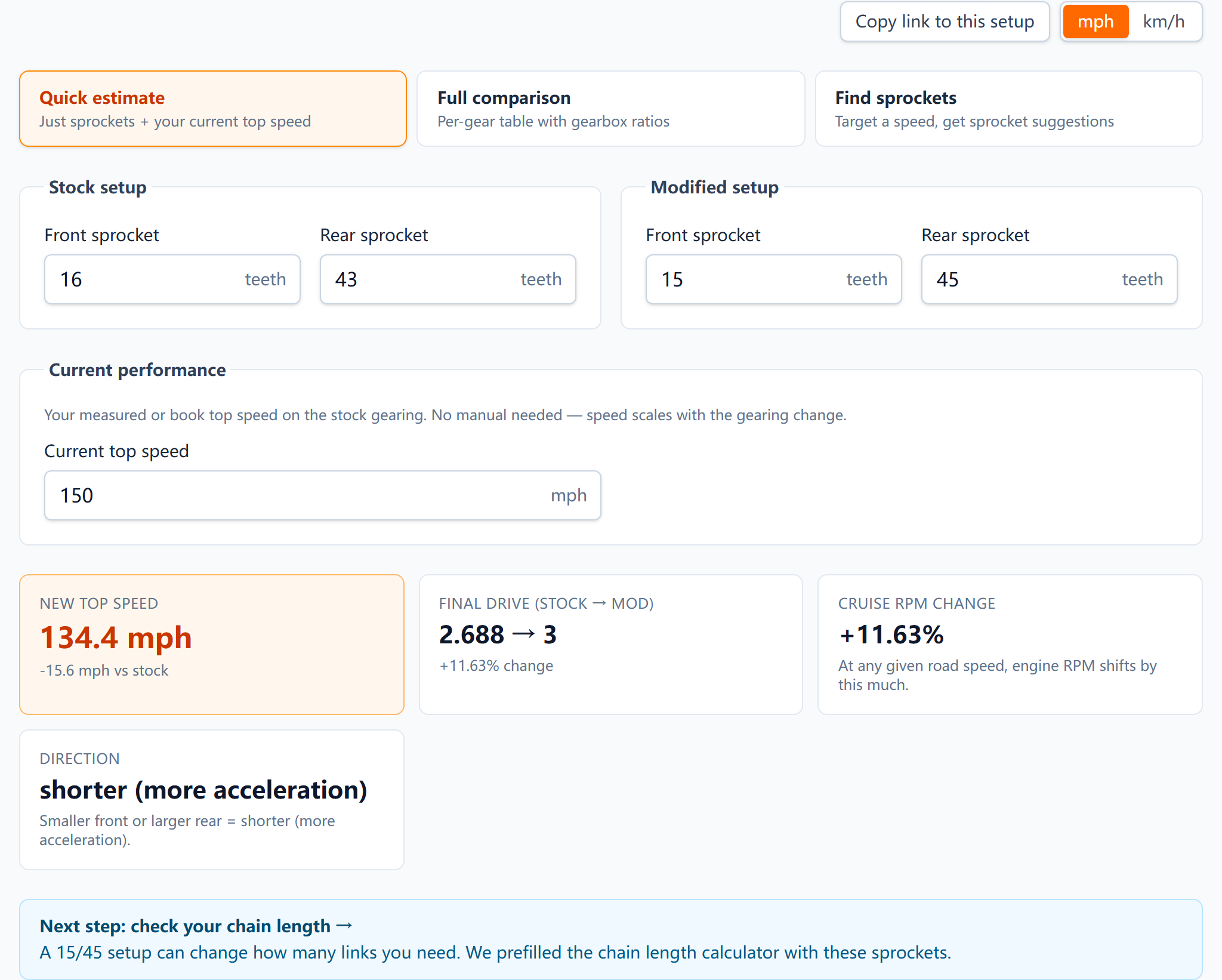
Stock 16/43 versus a popular 15/45 swap, primary 1.717, top gear ratio 0.851, 180/55-17 rear, redline 9,000 RPM:
- Final drive: 43/16 = 2.688 → 45/15 = 3.000, a +11.6% change.
- Top-gear overall ratio: 1.717 × 0.851 × 2.688 = 3.929 → 1.717 × 0.851 × 3.000 = 4.385.
- Top-gear theoretical speed at 9,000 RPM drops by about 15 mph.
- Engine RPM at a steady 60 mph rises by about 500 rpm — noticeable on the highway.
Trade-off: quicker out of corners, busier on the freeway. Most riders pair the swap with a slightly taller tire or sit it out if they commute long distances.
Formula source: Standard powertrain mechanics; cross-checked vs OEM gearing tables. Last reviewed: . Reviewed by the RiderCalc editorial team.
Frequently asked questions
How do I tell whether a change makes the bike "shorter" or "taller"? +
Smaller front sprocket or larger rear sprocket = higher final-drive number = shorter gearing = quicker acceleration and lower top speed. Larger front or smaller rear = lower final-drive number = taller gearing = more top speed but slower off the line. The calculator names the direction for you in the result.
What does a one-tooth change actually do? +
Dropping one tooth in front (16 → 15) on a typical sportbike adds roughly 6–7% final-drive. That is about 400 extra RPM at 60 mph in top gear and an extra 3–5 mph lost from theoretical top speed — a noticeable change you can feel everywhere except cruising.
Where do I find my bike’s gearbox ratios? +
Owner’s manual, factory service manual, or a Wikipedia spec sheet. Look for a list like 2.571 / 1.778 / 1.381 / 1.125 / 0.962 / 0.851 from first to top. Use those numbers in the "Gearbox ratios" field — the calculator multiplies them by the primary reduction and the new final-drive to get the overall ratio per gear.
Why does the formula need the tire size? +
Because the chain ratio only gets you to wheel RPM. To turn wheel RPM into mph you have to multiply by the tire’s rolling circumference. The default is a 180/55-17 rear; if you run a different size, swap the tire defaults in the Tire Size Calculator and use the diameter.
Does this account for tire growth at speed? +
No. Real tires grow a percent or two of their diameter at high RPM, which makes actual top speed marginally higher than the static calculation. For street use the difference is small enough to ignore; racers should add a 1–2% margin when chasing theoretical numbers.
What does "-1/+2" mean? +
Shorthand for dropping one tooth on the front sprocket and adding two on the rear — the most popular street/track gearing change. On a 16/43 bike that means 15/45, roughly a +12% final-drive change: noticeably quicker acceleration, about 400–500 extra RPM at highway speed, and a few mph off the theoretical top end. "-1" alone (front only) gives about half that effect for the cost of one cheap sprocket.
Will changing sprockets hurt my fuel economy? +
Shorter gearing (smaller front / larger rear) raises engine RPM at every cruising speed, so the engine spins faster on the highway and typically burns a few percent more fuel. Taller gearing does the opposite and can slightly improve economy on steady cruises. Around town the difference is usually too small to notice — riding style dominates.
Will my speedometer read wrong after a sprocket change? +
It depends where your bike measures speed. Bikes that sense speed at the wheel (most modern bikes with ABS rings) stay accurate after a sprocket change. Older bikes that take speed off the gearbox output will read wrong by exactly the final-drive change — shorter gearing makes the speedo over-read. A taller or shorter tire also shifts the reading; use our Tire Size Calculator to quantify that part.