Tire & wheels
Motorcycle Tire Size Calculator
Compare two tire sizes, see overall diameter and circumference, and check the speedometer error before you bolt a new tire on.
True road speed check
Enter an indicated speed (what the dial reads) to see your actual road speed on the new tire.
The formula
Motorcycle tire sizes follow the metric format WIDTH / ASPECT − RIM. From those three numbers we derive every dimension that matters:
Sidewall (mm)        = Width × Aspect / 100
Overall diameter (mm) = Rim × 25.4 + 2 × Sidewall
Circumference         = π × Diameter
Speedometer error %   = (D_new − D_old) / D_old × 100
Actual road speed     = Indicated speed × D_new / D_old
The math comes from the tire’s own geometry — there is no calibration table, no brand-specific tweak. Tire manufacturers publish their measured "section height" because real tires don’t perfectly match the mathematical aspect, but the formula gets you within ~1% of the printed spec for every street tire on the market.
Worked example
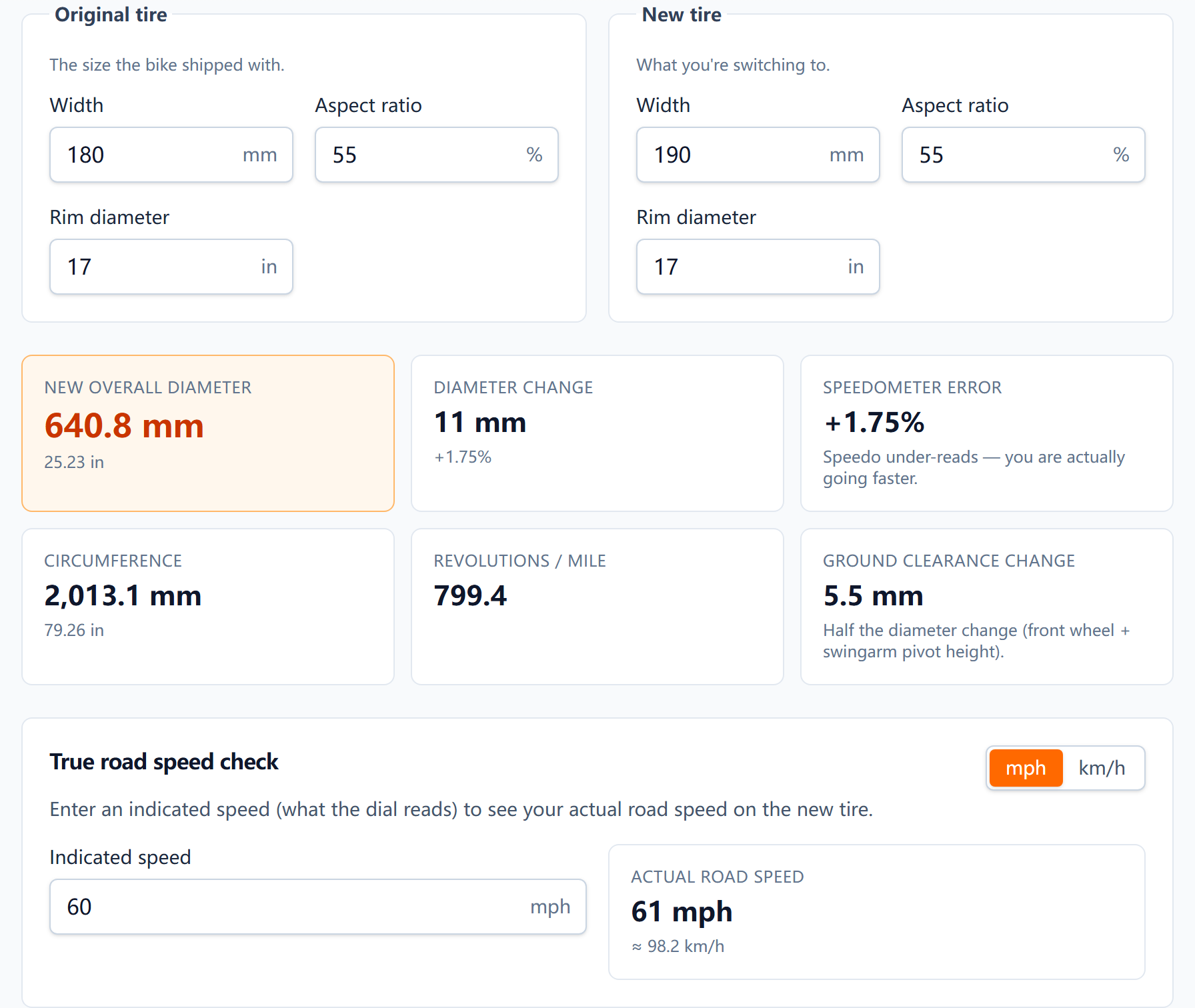
You're stepping a sportbike rear from 180/55-17 to 190/55-17:
- Old sidewall: 180 × 0.55 = 99 mm. Old diameter: 17 × 25.4 + 2 × 99 = 629.8 mm.
- New sidewall: 190 × 0.55 = 104.5 mm. New diameter: 17 × 25.4 + 2 × 104.5 = 640.8 mm.
- Diameter change: +11 mm, or +1.75% — your speedometer under-reads by about 1.75%.
- At an indicated 60 mph you’re actually going 61.0 mph.
Reading "180/55-17", piece by piece
Every metric motorcycle tire size compresses three measurements into one short code. Here is what each number actually means on a real tire:
- 180 = section width in millimeters (the tire’s widest point, not the contact patch).
- 55 = aspect ratio: sidewall height as a percentage of section width. So 180 × 0.55 = 99 mm.
- 17 = rim diameter in inches. Multiply by 25.4 to convert to mm.
Common OEM motorcycle tire sizes
Approximate OEM sizes by bike category — useful as a sanity check before ordering. Always confirm against the swingarm sticker, wheel stamp, or owner’s manual on your specific bike, especially for Harley-Davidson, BMW, and Indian models which vary heavily by year.
| Bike category | Typical front | Typical rear | Examples |
|---|---|---|---|
| Sportbike (600 cc) | 120/70-17 | 180/55-17 | CBR600RR, R6, GSX-R600, ZX-6R |
| Sportbike (1000 cc) | 120/70-17 | 190/55-17 or 200/55-17 | CBR1000RR, R1, GSX-R1000, ZX-10R, S1000RR |
| Naked / standard | 120/70-17 | 160/60-17 or 180/55-17 | SV650, MT-07, Z900, Street Triple |
| Adventure (street-biased) | 110/80-19 or 120/70-19 | 150/70-17 | R 1300 GS, Africa Twin, Tiger 900 |
| Adventure (off-road) | 90/90-21 | 150/70-18 | KTM 890 R, T7, Husqvarna 901 |
| Cruiser (small) | 100/90-19 | 150/80-16 | Sportster S, Rebel 500 |
| Cruiser (big twin) | 130/80-17 or 130/60-19 | 180/60-17 or 200/55-17 | Street Glide, Road King, Indian Chief |
| Touring | 120/70-17 or 130/70-18 | 180/55-17 or 200/55-16 | R 1250 RT, FJR1300, Gold Wing |
Wider, taller, or both?
A "plus-size" tire swap is really three independent decisions: section width, aspect ratio, and rim diameter. Each one does something different.
- Increase section width (e.g. 180 → 190 at same aspect): bigger contact patch in theory, but only if the rim is wide enough to support it. On a too-narrow rim a wider tire pinches into a taller, less stable profile that turns in slower.
- Increase aspect ratio (e.g. 180/55 → 180/60): taller sidewall, more compliance, more steering effort, slower turn-in. Rarely useful on a sportbike; common on cruisers.
- Change rim diameter: almost never on a street bike — the wheel itself has to change.
Rule of thumb: stay within the OEM rim-width range stamped on the wheel, and keep diameter changes under 3% to avoid ABS recalibration and clearance trouble. The calculator above flags this for you.
Formula source: ETRTO / Tire and Rim Association tire-spec standard; OEM size references cross-checked vs published spec sheets. Last reviewed: . Reviewed by the RiderCalc editorial team.
Frequently asked questions
How do I read a motorcycle tire size like 180/55-17? +
180 is the section width in millimeters, 55 is the aspect ratio (sidewall height as a percent of width), and 17 is the rim diameter in inches. So a 180/55-17 has a 180 mm wide tread, a 99 mm tall sidewall (180 × 0.55), and mounts on a 17 in wheel.
How much speedometer error does a tire change cause? +
Speedometers are calibrated to the original tire’s rolling diameter. If the new tire is 2% larger, the speedometer under-reads by about 2% — at an indicated 60 mph you are actually going about 61.2 mph. Anything past ~3% is worth correcting with a speed healer or ECU flash.
Will a wider tire fit my motorcycle? +
Section width changes more than just looks. Going from a 180 to a 190 in the same aspect ratio adds about 11 mm of overall diameter, raises the bike about 5.5 mm, and changes the tire’s natural profile. Always check the OEM rim-width range stamped on your wheel and verify swingarm clearance before riding.
Does a larger tire affect gearing? +
Yes. A taller tire effectively makes your final drive longer — you’ll lose a little acceleration and gain a little top-end RPM headroom. Use the Gear Ratio Calculator to see the change in real numbers.
What is "ground clearance change" in the result? +
It is half of the diameter change. A 10 mm taller tire raises the axle by 5 mm, which raises every static clearance measurement (oil pan, exhaust, side-stand angle) by 5 mm. The geometry effect on rake and trail is a separate calculation.