Buying
Motorcycle Loan Calculator
Run the real numbers before you sign. Price, tax, fees, APR, and term in — monthly payment and total interest out.
The formula
RiderCalc uses the same standard amortization equation as every US bank and credit union. There is no proprietary spread, no APR rounding, and no embedded promo offer:
Principal P = Price + Price × Tax% + Fees − Down − Trade-in
Monthly rate r = APR / 100 / 12
Monthly payment M = P × [ r·(1+r)^n ] / [ (1+r)^n − 1 ]
                    (n = term in months)
If r = 0 (rare promo financing):  M = P / n
Total interest = M × n − P
Total paid     = M × n
The amortization schedule then walks month-by-month: each row’s interest is the running balance times the monthly rate, the principal portion is whatever is left of the fixed payment, and the balance ticks down until the final month closes it out.
Worked example
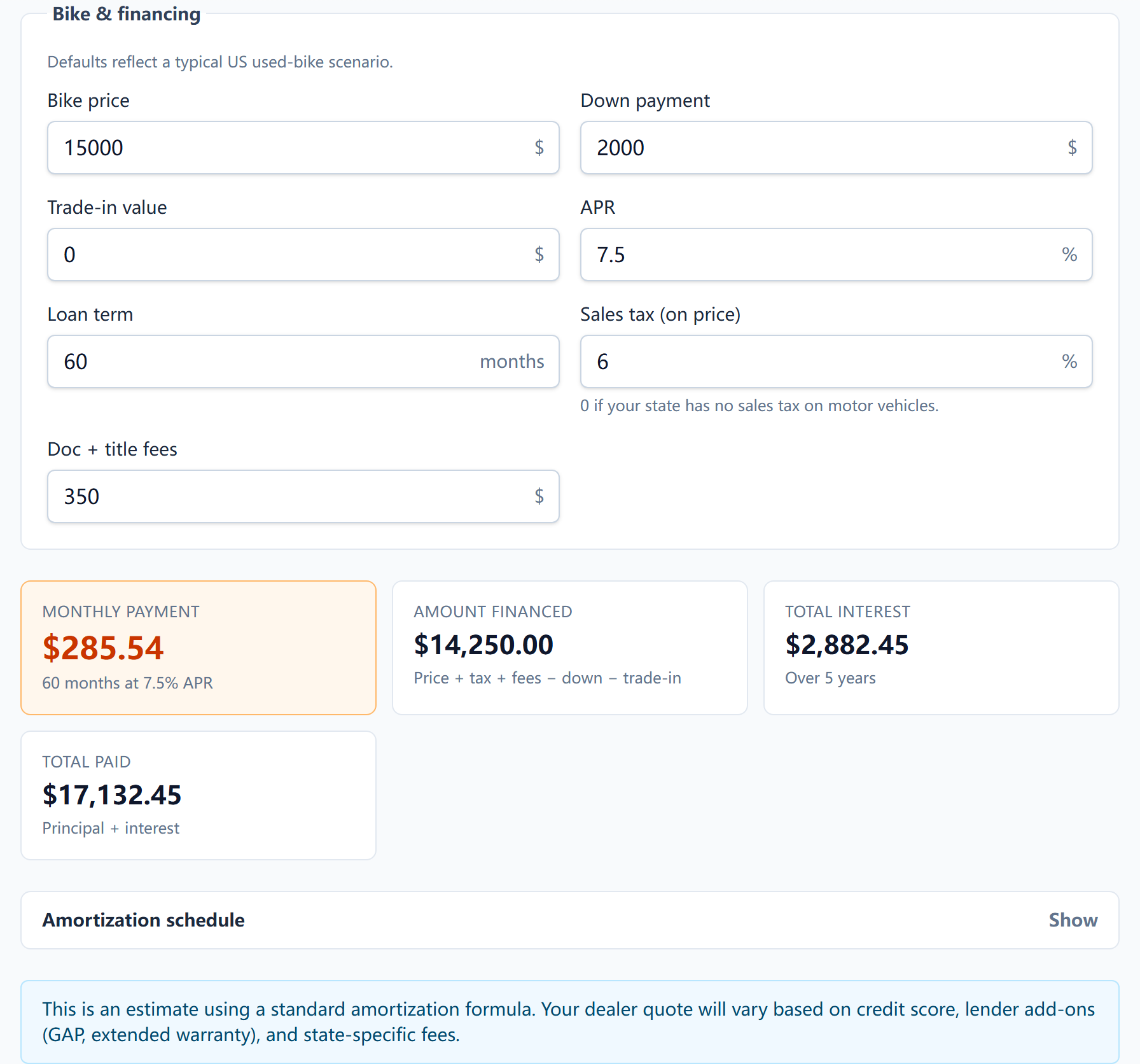
A $15,000 bike with a $2,000 down payment, no trade-in, 6% sales tax, $350 in doc + title fees, 7.5% APR over 60 months:
- Tax = 15,000 × 0.06 = $900. Principal = 15,000 + 900 + 350 − 2,000 − 0 = $14,250.
- Monthly rate = 7.5 / 100 / 12 = 0.00625. (1+r)^60 ≈ 1.4533.
- Monthly payment ≈ 14,250 × (0.00625 × 1.4533) / 0.4533 ≈ $285.55.
- Total paid ≈ $17,133. Total interest ≈ $2,883 over the life of the loan.
Worth noting: in month 1, almost $89 of the payment is interest; by month 60, it’s under $2. That curve is what makes early-payoff so powerful on shorter-term auto loans.
Typical 2026 motorcycle loan APRs by credit tier
Lenders price every motorcycle loan against your FICO score, the vehicle’s age, and the loan-to-value ratio. The ranges below are typical for a US borrower on a new or near-new bike, sourced from published rate sheets at major credit unions, banks, and powersport finance arms. Rates change weekly — treat this as a sanity check, not a quote.
| FICO score | Credit tier | New-bike APR | Used-bike APR |
|---|---|---|---|
| 760+ | Super-prime | 6.5%–8.5% | 7.5%–10% |
| 700–759 | Prime | 8%–10.5% | 9.5%–13% |
| 660–699 | Near-prime | 10.5%–14% | 12%–17% |
| 620–659 | Subprime | 14%–19% | 17%–23% |
| Below 620 | Deep subprime | 19%–26% | 22%–29% |
Captive lenders (Harley-Davidson Financial Services, Yamaha Financial Services, BRP Financial) sometimes run promo APRs as low as 2.99%–5.99% on new in-stock models — these are real, but they require strong credit and often shorter terms. Always cross-check a promo APR against a credit-union quote.
Term length: lower payment, much more interest
Stretching a motorcycle loan is the single fastest way to lower the monthly number — and the single fastest way to pay way more for the same bike. The table below is the same $15,000 financed at 7.5% APR across five terms, using the calculator above:
| Term | Monthly payment | Total interest | Total paid |
|---|---|---|---|
| 36 months | $467 | $1,794 | $16,794 |
| 48 months | $363 | $2,409 | $17,409 |
| 60 months | $301 | $3,033 | $18,033 |
| 72 months | $259 | $3,671 | $18,671 |
| 84 months | $230 | $4,319 | $19,319 |
Going from 36 to 84 months drops the monthly payment by 51%, but you pay 141% more interest. Bikes depreciate ~20% in year one and ~10%/year after that, so an 84-month note routinely leaves you owing more than the bike is worth for the first 3 years.
How each year of your payment is split
Every monthly payment is the same dollar amount, but the composition changes drastically. In month 1, the bank takes interest on the full $14,250 balance — so most of your payment is interest. By month 60, the balance is nearly zero, so almost the entire payment is principal. The chart below shows the 5-year breakdown for our worked example.
Dealer financing vs credit union vs personal loan
You have three realistic places to get the money. They are not equivalent.
| Source | Typical APR | Pros | Watch out for |
|---|---|---|---|
| Dealer F&I | +1–3% vs market | One-stop, instant approval, captive promo rates on new bikes | Rate markup, padded GAP/extended-warranty add-ons |
| Credit union | Lowest available | Best APR for prime credit, no markup, member-friendly terms | Membership required, slower (1–3 days), may require older bike to be loan-eligible |
| Personal loan | +3–5% vs secured | Unsecured (no lien on bike), works for any vehicle age, faster than CU | Higher APR, shorter terms (24–60 months), tighter credit gate |
The standard play: get a credit-union pre-approval before walking into the dealership. Then let the dealer "beat" the CU rate. If they can, take dealer. If they can’t, take CU. Either way you anchor the negotiation.
Five ways to lower your monthly payment
- Improve your credit score before applying. Going from 680 → 740 typically drops APR by 2–3 percentage points, which on a $15K / 60-month loan is ~$15/mo and $900 over the life.
- Put more down. Every $1,000 of down payment knocks roughly $20/mo off a 60-month loan at 7.5% APR.
- Shop multiple lenders within a 14-day window. FICO treats auto/motorcycle inquiries inside that window as a single hit, so you get rate competition without credit-score damage.
- Negotiate the bike price, not the payment. Dealer F&I will happily lower your "payment" by quietly extending the term. Negotiate price, then plug it into the calculator above.
- Skip rolled-in add-ons. GAP insurance ($300–800), extended warranties ($800–2,500), and "tire & wheel protection" almost always cost less when bought separately or skipped entirely.
Red flags in the F&I office
The Finance & Insurance desk is where dealerships make most of their margin. The math you ran with the calculator is the truth; anything else they add to the deal needs to justify itself. Specifically watch for:
- "Monthly payment" focus over total cost. If they will not write down the term, APR, and total interest, walk.
- Rate markup. The lender approves you at X%; the dealer quotes X+2% and keeps the spread. Ask point-blank: "What rate did the lender approve me at?"
- GAP insurance for $800+. Your auto insurer or credit union usually sells the same product for $200–400.
- Pre-paid maintenance plans on a chain-driven bike. The math almost never works out.
- "Optional" pre-filled boxes. Read the second-to-last page carefully — that is where the add-ons live.
Formula source: Standard amortization formula; rate ranges from published 2026 US credit-union, bank, and captive lender disclosures. Last reviewed: . Reviewed by the RiderCalc editorial team.
Frequently asked questions
How is the monthly motorcycle payment calculated? +
It uses the standard amortization formula: M = P × r(1+r)^n / ((1+r)^n − 1), where P is the financed amount, r is the monthly interest rate (APR ÷ 12 ÷ 100), and n is the number of months. The financed amount equals price + sales tax + fees − down payment − trade-in. The same formula is used by banks, credit unions, and dealer F&I offices.
What APR should I expect for a motorcycle loan in 2026? +
Rates depend on credit score, term, and lender. Prime borrowers (~750+ FICO) typically see 6.5–9% APR from credit unions and major banks. Subprime applicants can see 12–20% APR from dealer-arranged financing. Manufacturer captive lenders (Harley-Davidson Financial, Yamaha Financial Services, etc.) sometimes run promo APRs in the 3–6% range on new models — always compare against an outside lender.
Does this calculator include sales tax? +
Yes, optionally. Enter your state’s motor-vehicle sales tax rate in the "Sales tax" field. The calculator applies the percentage to the bike price and rolls the result into the amount financed. Most states tax the price minus trade-in, so reduce your price field by the trade-in if your state offers that credit.
Is a longer loan worth it for a lower payment? +
Mathematically, almost never. A 72-month loan at 8% APR has a lower monthly than a 36-month, but you’ll pay roughly 2× the total interest. Bikes also depreciate fast — stretching the loan past 48 months risks ending up "upside down" (owing more than the bike is worth) if you total it or want to sell. Use the amortization table to see how slowly principal drops in the early years.
Is this calculator a quote? +
No. It is a math estimate using a standard amortization formula. Real dealer offers include lender-specific fees (origination, GAP, extended warranty), credit-score-based rate adjustments, and state title costs. Treat the result as a sanity check before you walk into the F&I office.